
by Dr. Sam Ward and Prof. Hein Van Poppel – Medi-Sphere
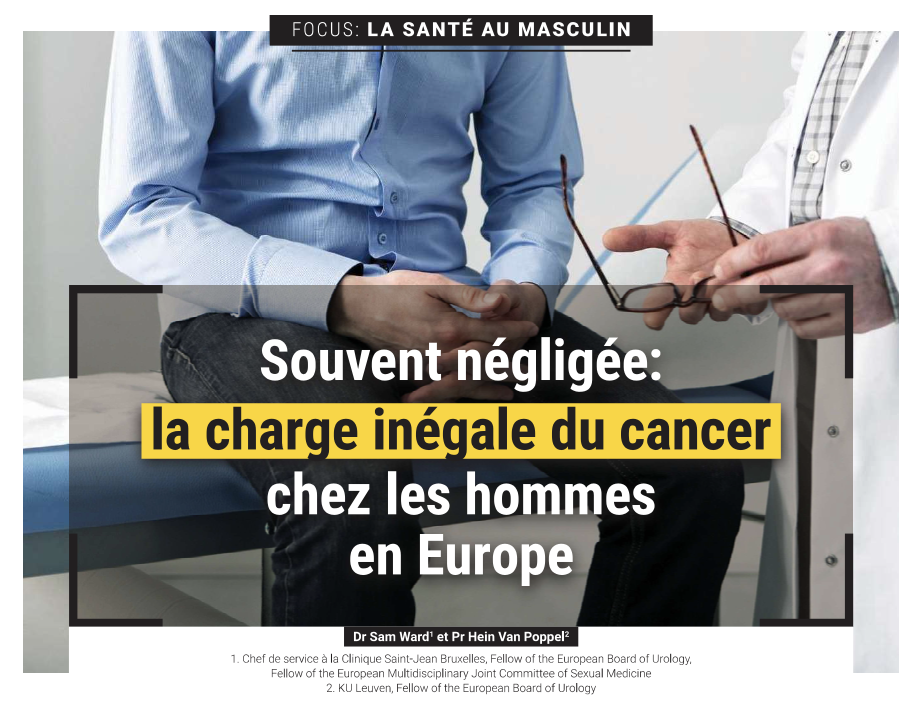
Men are affected by cancer significantly more often than women, a fact that healthcare policymakers often overlook. In 2020, the age-standardized cancer incidence rate among men in 40 European countries was 660 per 100,000, compared with 456 among women, with mortality rates of 348 and 200, respectively (1).
Higher incidence and mortality rates among men
The incidence and mortality rates for nearly all forms of cancer—with the exception of thyroid and gallbladder cancer—are higher among men. In particular, for lung, stomach, lip, oral cavity, and throat cancers, these rates are more than twice as high among men as among women. The incidence of prostate cancer is now even higher than that of breast cancer in women. A similar trend can be observed worldwide, with higher incidence and mortality rates among men (2).
What factors play a role here? There are several factors that explain this inequality:
- Behavioral factors: On average, men smoke and drink more than women, putting them at a higher risk of cancer (3).
- Occupational exposure: Men are more likely to be exposed to carcinogens at work (3).
- Access to and use of health care: Men are less aware of their own symptoms (4) and are more reluctant to seek help (5). Added to this are barriers to accessing primary health care, such as limited availability of appointments and concerns about privacy. Reference is also made to typical alpha-male behavior: the tendency to think that “it’ll be fine” (6).
- Biological factors: Differences in sex chromosomes are also a possible cause. This is because women have two copies of the tumor suppressor genes on the X chromosome (7).
What policy recommendations for the future?
To address these issues, the European Cancer Organization’s Inequalities Network organized a roundtable discussion in April 2022 that resulted in four key recommendations:
- Incorporating the gender dimension into cancer policy: recognizing and addressing the disproportionate burden of cancer among men, as part of efforts to address cancer inequalities. The gender dimension should become a key indicator. Furthermore, disparities in outcomes among men across different countries should be addressed in a coordinated manner (8).
- Targeted health interventions: Implement programs specifically designed for men to improve their health behaviors and use of health services (prevention). An example: the Football Fans in Training program in Scotland is a success story, in which the health outcomes of obese men improved thanks to a 12-week weight management and healthy living program led by community coaches (9). Technologies such as virtual reality games can also raise awareness about cancer (10).
- Prostate cancer screening and research: Establish screening programs using advanced risk assessment methods to prevent overdiagnosis and unnecessary treatments. Continue to invest in research, prevention, and access to new treatments for advanced forms of cancer. During this roundtable conference, a European initiative against prostate cancer was recommended, modeled after the European initiative against breast cancer (11).
- Develop a men’s health policy: implement a policy similar to Ireland’s national men’s health policy, which has led to improvements in men’s health literacy and health behaviors. Implement gender-neutral HPV vaccination programs and national prostate cancer screening initiatives, as mentioned in point 3 (12).
Conclusion
The fight against the excessive burden of cancer among men requires coordinated regional and national efforts that integrate gender-specific strategies into cancer policy.The European Cancer Organization aims to incorporate these recommendations into its advocacy programs in order to influence policymaking and improve cancer outcomes for men across Europe (13). This issue has been neglected for far too long and requires immediate attention. As a primary care physician, you have a role to play in this effort.
Role of primary care physicians: Primary care physicians can play a crucial role in reversing this trend by paying special attention to cancer prevention and early diagnosis in male patients during consultations for other issues. Since 2019, the HPV vaccine for boys has been covered by insurance in Belgium. However, data show that coverage is still insufficient. General practitioners can use public awareness campaigns to highlight the key symptoms of common cancers, encouraging men to visit their doctor more often and to be more vigilant (14).
References
1. Dyba T, Randi G, Bray F, et al. The European cancer burden in 2020: incidence and mortality estimates for 40 countries and 25 major cancers. Eur J Cancer 2021;157:308-47.
2. Sung H, Ferlay J, Siegel RL, et al. Global Cancer Statistics 2020: GLOBOCAN estimates of incidence and mortality worldwide for 36 cancer types in 185 countries. CA Cancer J Clin 2021;71(3):209-49.
3. Bertin M, Thébaud-Mony A, Counil E, Giscop93 Study Group. Do women and men have the same patterns of exposure to multiple carcinogens in the workplace? Ann Work Expo Health 2018;62(4):450-64.
4. Niksic M, Rachet B, Warburtion FG, Wardle J, Ramirez AJ, Forbess LJL. Awareness of cancer symptoms and barriers to reporting symptoms in England. Br J Cancer 2015;113(3):533-42.
5. Fish JA, Prichard I, Ettridge K, Grunfeld EA, Wilson C. Psychosocial factors influencing men’s help-seeking for cancer symptoms. Psychooncology 2015;24(10):1222-32/.
6. Mursa R, Patterson C, Halcomb E. Help-seeking and men’s engagement with their primary care physician. J Adv Nurs 2022;78(7):1938-53.
7. Dunford A, Weinstock DM, Savova V, et al. Tumor-suppressor genes that escape X-inactivation contribute to the sex bias in cancer. Nat Genet 2017;49(1):10-6.
8. Aapro M, Baker P. Men and Cancer: Raising the Issues. European Cancer Organization, 2022.
9. Hunt K, Wyke S, Gray CM, et al. A gender-sensitive weight loss and healthy living program for overweight and obese men. Lancet 2014;383(9924):1211-21.
10. Hegarty J, McCarthy M, Davoren M, et al. Enhancing men’s awareness of testicular diseases. HRB Open Res 2023;5:25.
11. Van Poppel H, Roobal MJ, Chapple CR, et al. Prostate-specific antigen testing as part of a risk-adapted early detection strategy for prostate cancer. Eur Urol 2021;80(6):703-11.
12. Moffat J, Bentley A, Ironminger L, Boughey A, Radford G, Duffy S. The impact of national cancer awareness campaigns. Br J Cancer 2015;112(Suppl 1):S14-21.
13. European Council Press Release. Council Updates Its Recommendation on Cancer Screening, 2022.
14. Richardson, N., and Carroll, P. National Men’s Health Policy 2008–2013. 2008.