
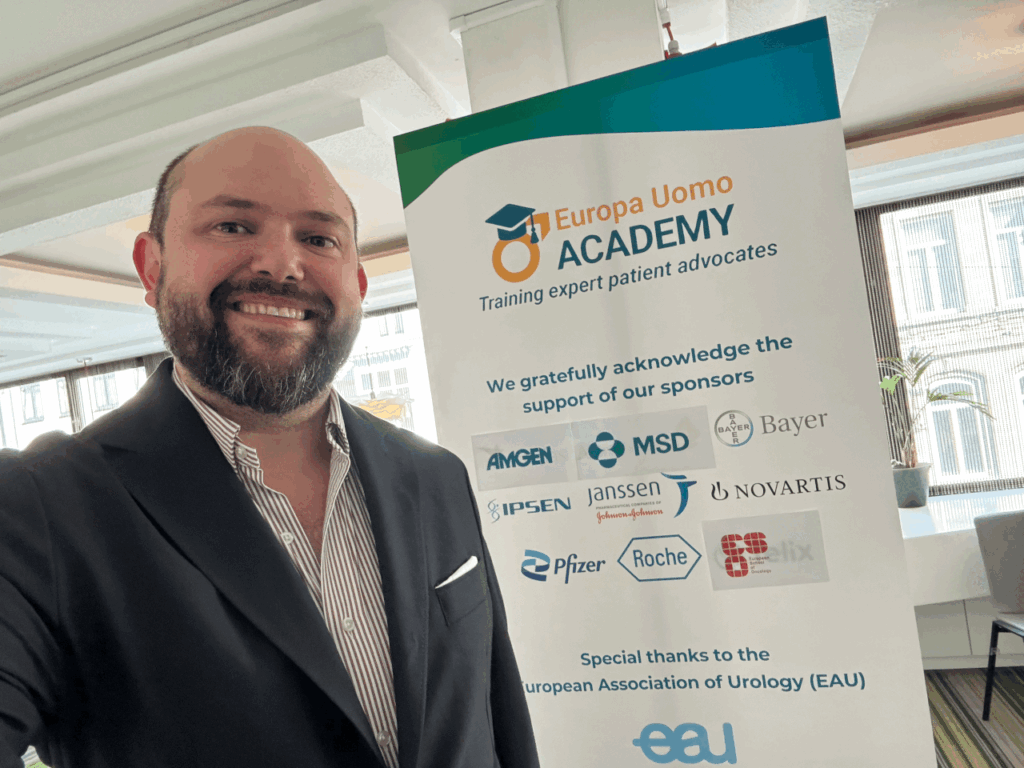
Last night, I spoke at the Europa Uomo Academy about sexual dysfunction and sexual rehabilitation after prostate cancer. This academy is all about patient empowerment! Twenty-seven people from various countries were in attendance. Impressive.
A special word of thanks to Andre Descamps of Wij Ook Belgium vzw for his excellent introduction and for so clearly bringing the patient’s perspective to the forefront of the discussion.
One story in particular has stayed with me: a patient said he waited 16 years before he discovered that penile prostheses existed.
Sixteen years.
That is striking, but it also raises a broader question for us as a medical community: Are we providing information to patients in a way that they can understand, remember, and refer back to later?
Before undergoing treatment for prostate cancer, patients have to process a vast amount of information. Understandably, their primary concern is the cancer itself. Therefore, it is not enough to explain the sexual consequences and rehabilitation only once, before surgery.
We need to explain, repeat, reassess, and support shared decision-making throughout the entire cancer care journey.
This is also why initiatives such as the shared decision-making guide, developed by Wij Ook Belgium vzw, are so valuable: patients need accessible resources that help them understand their options, articulate their priorities, and actively participate in decisions about their care.
And solutions do indeed exist.
Depending on the individual patient, these may include medication, injections, mechanical treatments, and penile prosthesis surgery. Sexual recovery goes far beyond erections: orgasm, ejaculation, changes to the penis, climacturia, intimacy, and the impact on the partner all deserve attention.
On October 3, we are organizing, in collaboration with Wij Ook Belgium vzw, a special patient event at the Sint-Jan Clinic in Brussels, specifically to provide patients and their partners with clear, evidence-based information on these topics.
The patient who waited 16 years is a powerful reminder. But the message is broader: prostate cancer follow-up cannot be reduced to PSA monitoring alone.
Oncological follow-up remains essential, but effective survivorship care must also take into account how the patient actually lives after treatment.
Cancer follow-up should be about survival—and about quality of life.
Early referral of patients to specialized professionals is recommended.
#Urology #Andrology #Patient Education #EuropaUomo
Boston Scientific Urology, Coloplast, Rigicon® Innovative Urological Solutions, Koenraad van Renterghem — thanks to the sponsors who make events like this possible, and to all the faculty members who took the time to participate (too many to tag): Hein Van Poppel, Bertrand Tombal