
by V.Li – The Specialist
Dr. Ward Sam, a urologist at Clinique St Jean, left on June 11 for a humanitarian mission to Mongolia and spent a week full of experiences with fellow surgeons in the urology department of a regional hospital. Testimonial … As part of a humanitarian program subsidized by the Belgian government and led by FSE—an organization that manages funds to improve, among other things, healthcare services and equipment in Mongolia (as well as in other countries in Africa and the Americas)—Dr. Ward Sam, a urologist at Clinique Saint-Jean in Brussels, reflects on this field experience and how it came about.
“This organization, FSE, had contacted the Saint-Jean Clinic because it was short on doctors for Mongolia: ophthalmologists, urologists, orthopedists… In fact, more doctors from Saint-Jean will be leaving for Mongolia in October. When I arrived in the country after a day and a half of travel, I went to the urology department of a hospital in the Khovd region, a province in the far west of the country, in the capital of the same name. A city with about 80,000 residents. This single hospital also serves the 300,000 residents who come from the region’s steppes. The Mongolians are originally nomads who still live with their herds (cows, horses, goats) in yurts on the Mongolian steppes.
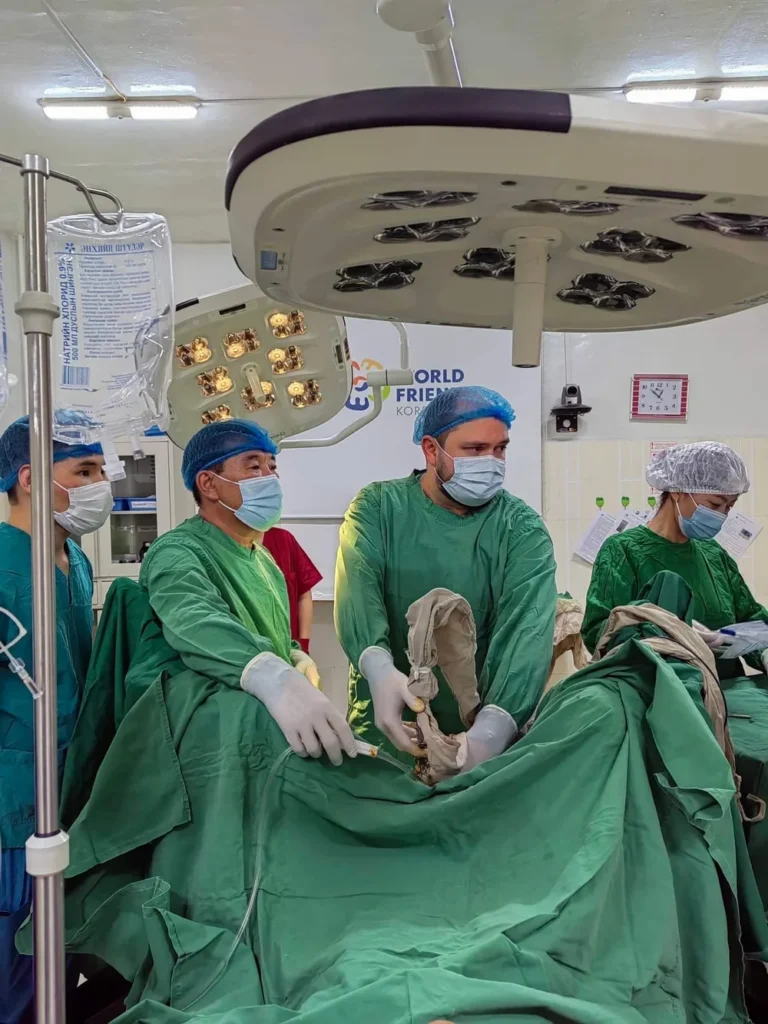
A Lack of Resources At this hospital, Dr. Ward discovered the CT scanner that was purchased three years ago thanks to support from the Belgian government. “The hospital also recently acquired a ureteroscope, and I was there to train the five surgeons—including a urologist—in how to use this device. These are surgeons who also have to perform daily surgeries on the appendix, gallbladder, and so on. “We’ve noticed that the guidelines they use don’t align with international guidelines and that they have a severe shortage of resources. Let me give just one example: they have a ureteroscope, but no laser.”
So the patient has to travel 1,500 km to receive additional treatment…
Eventually, they will need to purchase a laser, especially since there are a large number of patients who eat a lot of red meat and few vegetables, and don’t drink enough water… all of which are risk factors for urinary tract stones.
The Language Barrier This training program was able to take place thanks to the presence of a translator. English is a language they do not speak. Fortunately, English is gradually being used more and more in the country’s medical education: “In the past, doctors were trained in Mongolian. For the past two or three years, they have been trained in English, giving them access to a vast amount of medical information. This is essential for their continuing education.” Healthcare resources in Mongolia are all concentrated in the capital, Ulaanbaatar. “I was able to visit the country’s second university hospital: they have the same ultrasound equipment there as in Brussels. …but in the provinces, the standard of care is unfortunately not the same.”
Working conditions for doctors are very difficult. For example, there’s a radiology room with two ultrasound machines and two examination tables, with no curtain separating the two tables. No air conditioning, no chairs.” The international situation doesn’t make it any easier for them to get supplies either: “They’re located between Russia and China and are very dependent on medical equipment and medications. Since the COVID-19 pandemic, the Chinese border has been closed, and now there’s also the war in Ukraine… So they only have the airlift to get their supplies.”
Telemedicine: This isolated location and the lack of resources outside the major cities do not prevent the country from paying attention to modern medical advancements that could help them in the long run: “The discussion around digital healthcare is progressing there: I spoke specifically about telemedicine during a presentation for the entire medical staff. They understood its importance in the medium term, especially given how widely dispersed the patients are. We mustn’t forget that Mongolia is a country 50 times larger than Belgium, with a population of 3 million. Telemedicine is therefore a solution for avoiding unnecessary travel.” This technology allows them to make their medical resources more accessible: “It even enables them to seek advice from doctors and specialists in the capital or major cities without the patient having to travel. They plan to invest in this area in the coming years. Finally, the fact that 4G is widely available (and affordable) in the country’s cities is an added advantage. Moreover, all residents have a smartphone, even in their yurts.”
Sexual Health Dr. Ward also took the opportunity to highlight the importance of sexual health: “In Mongolia, there is only one medical school, but it does not cover all topics related to sexual health. The only things they discuss are fertility and erectile dysfunction resulting from metabolic syndrome. ” So the curricula do not emphasize the importance of consent, perinatal issues, gender, etc. “I had the opportunity to meet with the head of the medical school who sets the curriculum. He is very interested in developing a program on sexual health, as well as in using prevention and education tools, particularly digital ones. They are all the more interested because they are currently working on a population-level awareness campaign to reduce the number of unwanted teenage pregnancies…” In any case, this experience was very enriching for Dr. Sam Ward: “I recommend that other doctors, if they get the chance, seek out these kinds of experiences. FSE is always looking for volunteer doctors for missions in various countries, which gives you a different perspective on the work of your colleagues and allows you to share your knowledge in a meaningful way.”